

Now is the time for listing DiDi shares on the Hong Kong Stock Exchange.
Persistent Corporate Governance Problems
Independent Director Seat to Represent Us Left Vacant - 3 Years
No Shareholder Meetings - 4 Years
No Public Earnings Calls With Investors - 5 Years
No Disclosure of Plans to Relist Shares in Hong Kong - 4 Years
Now is the time for listing DiDi shares on the Hong Kong Stock Exchange.
Persistent Corporate Governance Problems
Independent Director Seat to Represent Us Left Vacant - 3 Years
No Shareholder Meetings - 4 Years
No Public Earnings Calls With Investors - 5 Years
No Disclosure of Plans to Relist Shares in Hong Kong - 4 Years
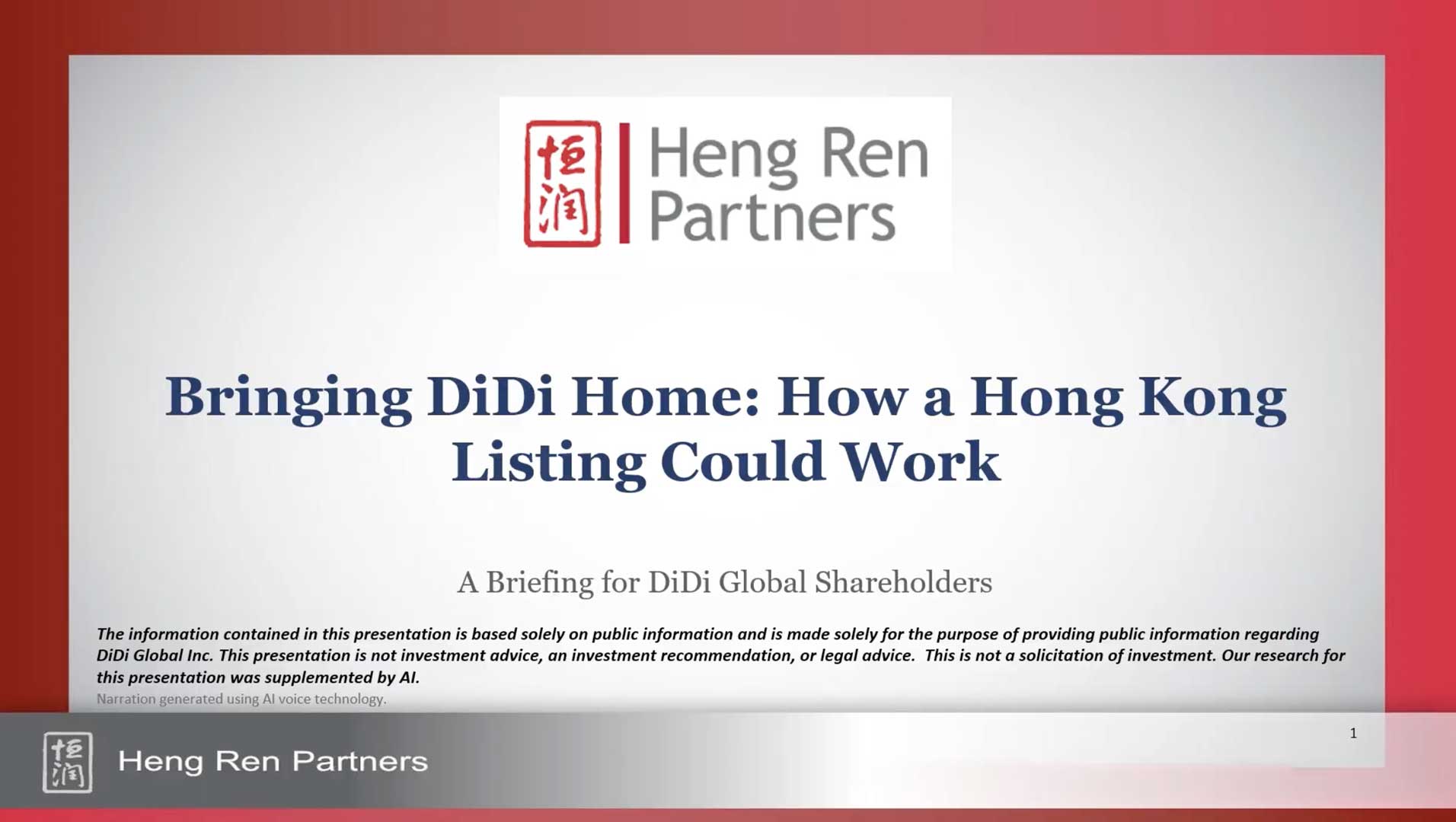
Watch this video about how DiDi shares can be listed in Hong Kong
Bring DiDi Home
DiDi Global has languished in exile on OTC (Over-the-Counter) since 2022 when it delisted its shares from the NYSE. DiDi shareholders now are suffering because the most important investors - large institutional and index-driven investors - can't invest in DiDi because it trades OTC, a less-regulated venue known for trading penny stocks. This significantly lowers demand for DiDi shares and harms their value and our holdings. This can be corrected by listing the shares of this Chinese and global leader in mobility on the Hong Kong Stock Exchange.
Send Your Message to the DiDi Board:
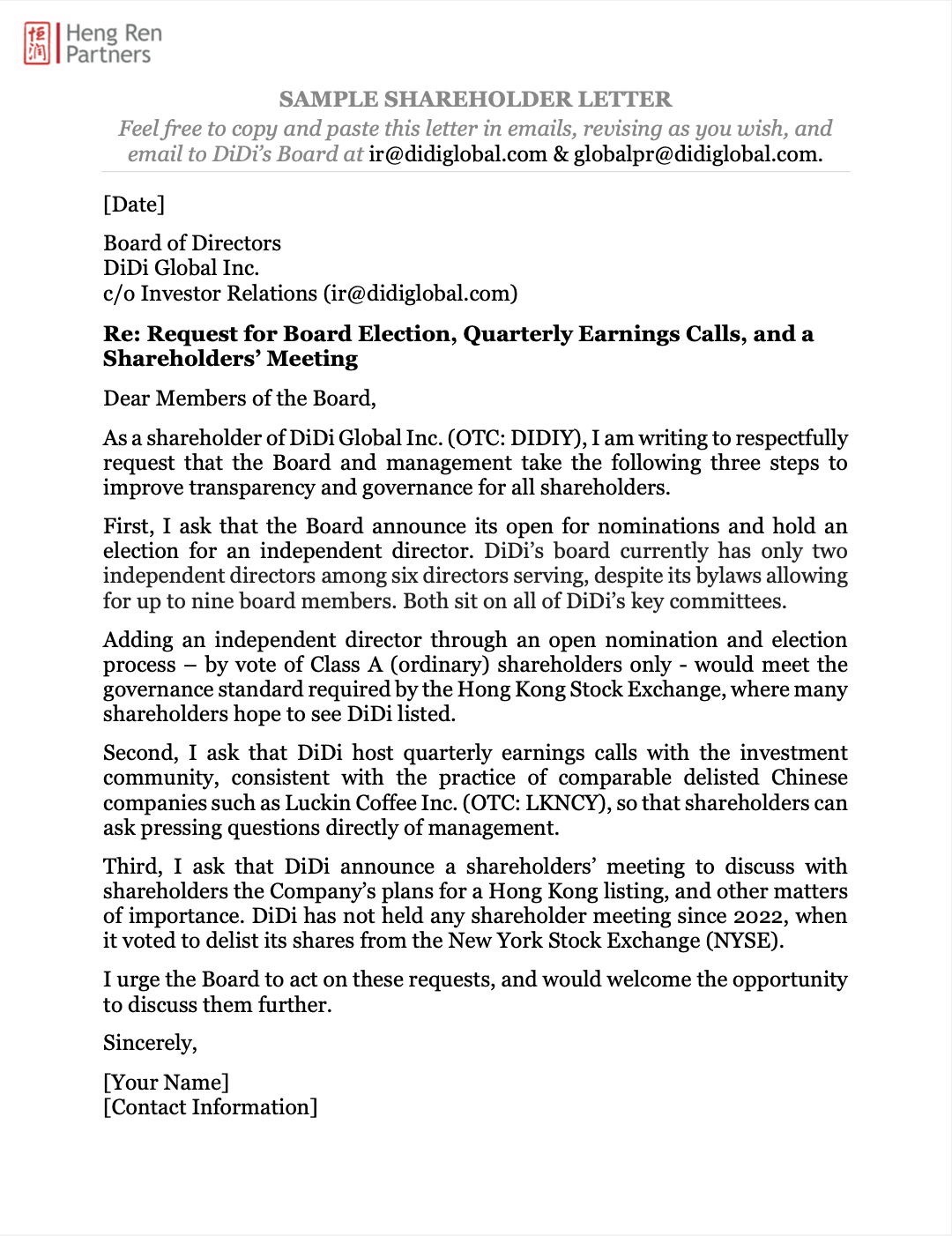
Announce a Shareholders' Meeting (the first in four years) to Consider a Hong Kong Listing, and Call an Election.
The problem with OTC. What Heng Ren is doing. What this page is about.
The problem with OTC: DiDi Global's stock has been stuck for four years trading on the U.S. OTC market trading on "pink sheets," through brokers only and without a listing on an exchange. OTC is identified with penny stocks and shell companies, not a global leader of DiDi's size (market cap $16 billion). This OTC status cuts off index funds, institutional investors, and the basic liquidity that a global business - and its large major shareholders - should have.
Why Heng Ren is leading this: Heng Ren's funds are long-term DiDi shareholders. We have spent months researching why a Hong Kong listing is the obvious fix to erase this discount. We're sharing our research to organize fellow shareholders to join us in the initiative for DiDi's shares to be "uplisted" to a well-known stock exchange, like the Hong Kong Exchange, in Greater China.
What this page is about: Here you'll find Heng Ren's research, letters to DiDi's board and its largest shareholders, and simple ways to add your own voice. We believe the more shareholders who ask for this uplisting to the Hong Kong Stock Exchange, the stronger our collective voice and our chances are to be heard. Nothing has been done for four years at the expense of shareholder value.

Company Snapshot
DiDi Global Inc. (OTCPK: DIDIY) is a leading mobility technology platform headquartered in Beijing, China. DiDi has a dominant 70% market share in China and operates in 24 countries. The company provides a comprehensive suite of app-based services, including ride-hailing, taxi-hailing, chauffeur, and hitch options. Beyond passenger transport, DiDi operates electric vehicle charging networks, auto maintenance services, food delivery, and intra-city freight. The company leverages advanced AI and data analytics to optimize urban transit across China and key international markets like Latin America.
How much is DiDi worth?
Heng Ren's own valuation estimate is actually slightly below the top end of Wall Street analysts' consensus valuation of $6.50 - or 86% upside. DiDi trades at roughly 0.8x Enterprise Value (EV)/Adjusted Sales, versus 2.5x for Uber (NYSE: UBER), 2.25x for Grab Holdings Ltd. (NASDAQ: GRAB), and 3.6x for Caocao Inc. (HKEX: 2643) — despite running a larger, more dominant business than most of these peers. We believe the biggest contributing factor to DiDi's discount is its OTC trading status. Academic studies estimate the OTC discount to be at least 30%-40%.
Get The Ticket!
Heng Ren publishes a regular email newsletter with the latest information and insights about our effort to see DiDi Global listed on the Hong Kong Stock Exchange to end its exile in the U.S. OTC (Over-the-Counter) market. If you're a shareholder interested in this positive change, The Ticket is the best way to stay current.
And visit our archive of recently published editions.
How Did DiDi Get Here?
A blockbuster IPO, cut short. On June 30, 2021, DiDi Global went public on the New York Stock Exchange (NYSE) in one of the largest IPOs of that year — raising $4.4 billion, with shares opening at a price of $16.65. Within days, Chinese regulators opened a cybersecurity review and froze new user sign-ups. The core issue was DiDi had reportedly gone public without properly clearing the listing through the right government channels first. It was a procedural violation that Beijing took seriously.

The reckoning. DiDi reportedly was fined roughly RMB 8 billion (approximately $1.2 billion today) for data-related violations. By December 2021, DiDi announced it would delist from the NYSE, which shareholders approved in May 2022. On June 13, 2022, DiDi's American Depositary Shares (ADS) delisted from the NYSE for good — landing on OTC and trading "pink sheet" among brokers and alongside discarded penny stocks and shell companies - because there was nowhere else left for DiDi to trade.
DiDi made the effort to come back. By January 2023, DiDi had presumably completed its rectification process with regulators in China and resumed normal operations. In the years since, the underlying business has recovered: DiDi returned to profitable growth, with roughly 70% of China's ride-hailing market, and is expanding internationally. Presumably DiDi did what was asked and recovered within the requirements of Chinese regulators, as far as what's publicly known.
But DiDi's odyssey continues. DiDi's business recovered, but its shares remain in exile. Average daily trading value has collapsed 84% since delisting. DiDi is missing from every major global index. It's held by only seven U.S. ETFs, versus 405 ETFs for Uber - simply because it's disqualified by index investors due to its OTC status. None of that reflects how the company is actually performing - it reflects where the shares trade.
The door that's now open. For the past few years Beijing has encouraged U.S.-listed Chinese companies to relist in Hong Kong. The Hong Kong Stock Exchange has rewritten its rules specifically to ease this path. As for the sensitive issue of data security of ride-hailers, a smaller domestic peer, CaoCao, listed in June 2025 in Hong Kong — setting precedent by clearing a regulatory review that DiDi presumably would need to pass. Now CaoCao is a member of eight Hong Kong indices and eighteen ETFs. DiDi, despite being roughly 15X CaoCao's size, sits inside zero indices in China.
Why this matters. DiDi's shares have languished in exile on OTC. Ultimately the cost lands on shareholders as DiDi shares trade at a steep, avoidable discount to their actual value. Our initiative seeks to erase this discount. If successful, many will benefit: DiDi shareholders, employees, institutional investors, investment banks, traders, foreign investors in China, potential DiDi drivers in China and globally, regulators who set the bar for a successful recovery, and the capital markets of Greater China, to name some. Also the major shareholders - like Uber, Softbank, and Tencent - can sell some of their shares during a Hong Kong IPO and finally monetize their investment - which is long overdue for their patient shareholders.
Our Goal
Heng Ren will organize DiDi shareholders who agree with us to communicate with DiDi's Board of Directors and request that they appreciate this problem and solve it by listing DiDi shares in Hong Kong. This will include communicating with DiDi's Board via email, letter, and on social media. The Board's primary and fiduciary responsibility is to do what's in the best interests of all shareholders. Uplisting DiDi's shares to Hong Kong from the OTC market in the U.S. would be a major upgrade in credibility, investor demand, and we believe, shareholder value.
What Comes Next - You Send a Message
Shareholders who want to join the initiative can join as a subscriber here. We will regularly update you with news and information about DiDi and the status of this initiative. Listed below are form letters that are available for emails to the decision-makers. Instructions for sending your messages are in each letter. We encourage you to send them to:
- Message to the DiDi Global Board
Email letters to the boards of major shareholders who own 41.4% of DiDi shares below:
Message to the board of SoftBank Group Corp. 21.5% owner (968.5 million DiDi ADS)
Message to the board of Uber Technologies 12.8% owner (575.6 million DiDi ADS)
- Message to the board of Tencent Holdings 7.1% owner (322.1 million DiDi ADS)
ADS = American Depositary Shares. This is what's traded on OTC. There are four (4) ADS for each Class A (ordinary) DiDi share.
Heng Ren documents about DiDi:
Don't Get Caught Short - Stay in the Know
Join our mailing list and get the latest on what's happening with DiDi Global through our regular newsletter, The Ticket.